





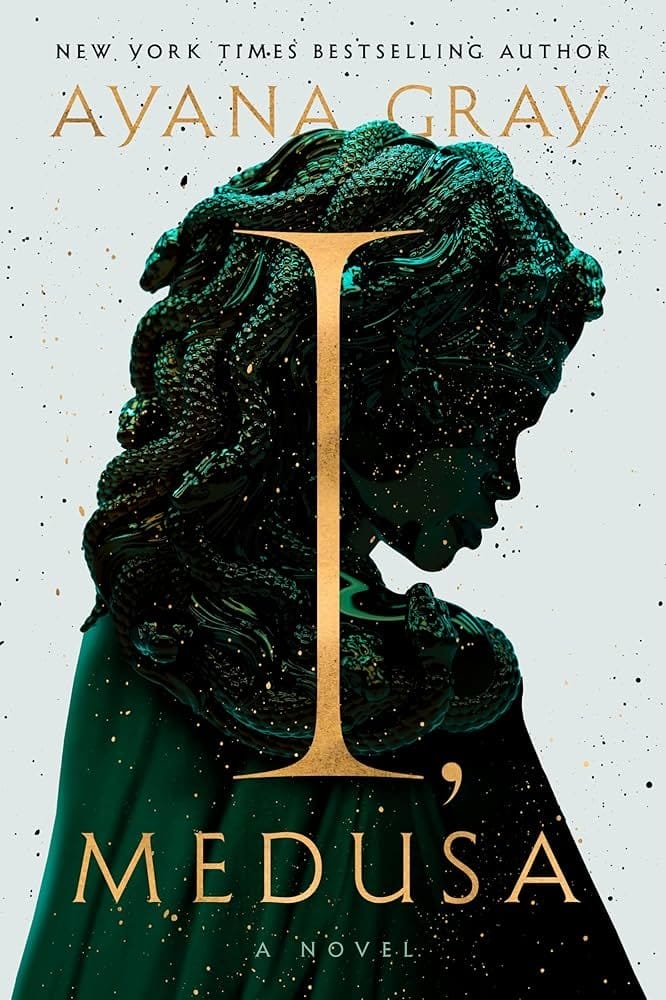

I, Medusa
By Ayana Gray
From New York Times bestselling author Ayana Gray comes a new kind of villain origin story, reimagining one of the most iconic monsters in Greek mythology as a provocative and powerful young heroine.
Meddy has spent her whole life as a footnote in someone else’s story. Out of place next to her beautiful, immortal sisters and her parents—both gods, albeit minor ones—she dreams of leaving her family’s island for a life of adventure. So when she catches the eye of the goddess Athena, who invites her to train as an esteemed priestess in her temple, Meddy leaps at the chance to see the world beyond her home.
In Athens’ colorful market streets and the clandestine chambers of the temple, Meddy flourishes in her role as Athena’s favored acolyte, getting her first tastes of purpose and power. But when she is noticed by another Olympian, Poseidon, a drunken night between girl and god ends in violence, and the course of Meddy’s promising future is suddenly and irrevocably altered.
Her locs transformed into snakes as punishment for a crime she did not commit, Medusa must embrace a new identity—not as a victim, but as a vigilante—and with it, the chance to write her own story as mortal, martyr, and myth.
Exploding with rage, heartbreak, and love, I, Medusa portrays a young woman caught in the cross currents between her heart’s deepest desires and the cruel, careless games the Olympian gods play.
My thoughts:
I love a good Greek mythology retelling and that’s exactly what I got with this book. Medusa has always been one of the most misunderstood figures in mythology. Depending on the version you grew up with, she’s either a terrifying monster with snakes for hair or a tragic victim with snakes for hair. Ayana Gray gives us a look at both versions of the myth and offers up a layered, emotional, deeply human story.
From the first chapter, this book pulled me in. Meddy (as Medusa’s known by friends and family) is introduced not as a creature or a curse but as a young woman who just wants something more. She doesn’t fit neatly into her family. Her sisters are immortal, beautiful, and adored. Her parents are minor deities with their own expectations. As a human, Meddy feels invisible and destined for a life that doesn’t satisfy her.
Her chance for something more comes when Athena takes notice and invites her to train as a priestess. Suddenly, Meddy is thrown into a world full of ritual, intrigue, and the heady rush of finding your place. These chapters were some of my favorites. This is where we see who Meddy is as a person. She’s kind, she sticks up for the underdog and she’s a loyal friend.
And then Poseidon enters the picture. Anyone familiar with Medusa’s myth knows this part is coming, but Ayana Gray handles it with a lot of care. There is no question about who holds the blame or who wronged who. The gods are messy, selfish, careless beings and just as much so in this retelling. Meddy’s transformation into the Medusa we know isn’t treated like a monster origin story. It’s a punishment for a crime she never committed. It’s trauma weaponized by a goddess who should have protected her. It’s a woman (a Black woman no less) being used as a scapegoat, and punished for something that a powerful man did.
The book also gives attention to Medusa’s sisters and how they, too, became snake women who can turn a man to stone just by looking at him. The Gorgons as a trio often get flattened into “mythical creatures,” but here they’re family and their story is fleshed out and highly nuanced. The bond between them is realistic and believable. Their relationship is complicated but loving and makes the last few chapters all the more heartbreaking.
What impressed me most was the balance of beauty and grief. The prose is lush. The emotional beats hit hard. It’s a retelling that respects the original myth while refusing to let it define the character’s entire worth.
Even knowing how the myth ends, this version still got to me. That’s how strong the writing is. Gray uses familiar beats but fills them with emotion and immediacy in a way that makes the story feel new again. Medusa isn’t a monster here. She’s a girl who was hurt, dismissed, punished, and forced into legend against her will. And the men who crossed her path? Yeah… let’s just say they earned what they got.
If you’re someone who loves Greek mythology, feminist retellings, or stories that reclaim narratives from the margins, this book is definitely worth picking up. This one lingers. It’s tender, furious, and full of meaning. I really enjoyed it.


