




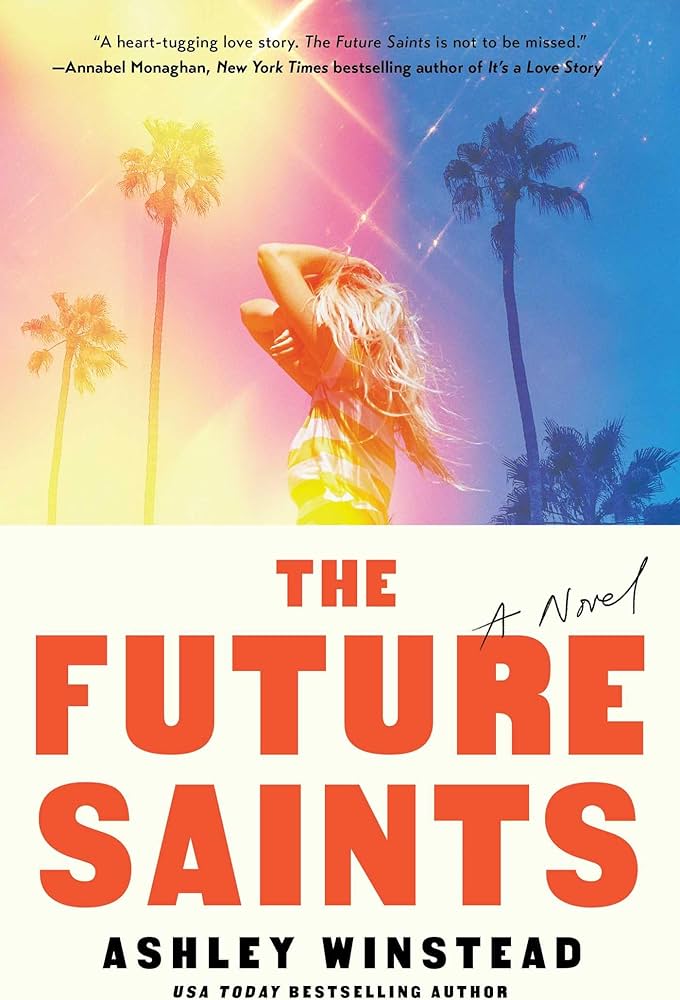

The Future Siants
Perfect for fans of Daisy Jones and the Six and In Five Years—a beautiful, powerful, and transportive new novel about a music executive desperately trying to bring a rock band back from the brink, from bestselling author Ashley Winstead.
This is a love story, but not the one you’re expecting.
When record executive Theo meets the Future Saints, they’re bombing at a dive bar in their hometown. Since the tragic death of their manager, the band has been in a downward spiral and Theo has been dispatched to coax a new—and successful—album out of them, or else let them go.
Immediately, Theo is struck by Hannah, the group’s impetuous lead singer, who’s gone off script by debuting a whole new sound, replacing their California pop with gut-wrenching rock. When this new music goes viral, striking an unexpected chord with fans, Theo puts his career on the line to give the Saints one last shot at success with a new tour, new record, and new start.
But Hannah’s grief has larger consequences for the group, and her increasingly destructive antics become a distraction as she and her sister Ginny—her lifelong partner in crime—undermine Theo at every turn. Hannah isn’t ready to move on or prepared for the fame she’s been chasing, and the weight of her problems jeopardize the band, her growing closeness with Theo, and, worst of all, her relationship with her sister—all while the world watches closely. The Future Saints’s big break is here—if only they can survive it.
A novel about sisterhood, friendship, and the ghosts that haunt us, The Future Saints is “a mesmerizing look at grief, love, and the music industry that’s so raw and emotional, you’ll want to play it on repeat.” (Laura Hankin, author of One-Star Romance).
My thoughts:
This was my fourth Ashley Winstead book, and I’m still a little on the fence with her overall. Aside from The Last Housewife, I haven’t yet finished one of her books feeling something big and lingering. That said, I respect what she did here. This is a clear step away from her usual crime and thriller lane, and she handles the shift with confidence. The writing is solid, the characters feel realistic, and the world she builds around the band and the industry feels believable.
The setup centers on record executive Theo, who discovers the Future Saints in rough shape, bombing at a dive bar in their hometown. Since the tragic death of their manager, the band has been spiraling, and Theo is sent in with a simple mission: coax a successful new album out of them or cut them loose. Theo’s job is to make them profitable again, and he’s used to smoothing rough edges into something marketable.
Then he meets Hannah.
Hannah is the band’s lead singer, and she’s a volatile, compelling presence from the start. She’s also drowning in grief. Her sister Ginny is dead, and Hannah’s loss shapes everything about her: her anger, her impulsiveness, her need to control the narrative, and the way she keeps pushing until something breaks. Winstead portrays Hannah’s grief as jagged and destabilizing, not inspirational and tidy. Hannah isn’t moving through loss in a straight line. She’s ricocheting off it, sometimes weaponizing it, sometimes collapsing under it, often doing both in the same scene.
One of the strongest parts of the book is how clearly it shows grief as something that can distort your choices. Hannah’s pain isn’t just a backstory detail. It’s a current, active force that bleeds into the band’s dynamics, the tour, and her increasingly risky behavior as their new sound goes viral. The book does a good job capturing that specific kind of self-destruction that can come from feeling like the worst thing already happened, so why bother trying to be safe?
I also thought Winstead did a great job portraying the music industry. Talent gets treated like a commodity, especially when the artist is young and female. The industry is framed as a machine that feeds on vulnerability and sells it back as authenticity. People in power push boundaries, manipulate narratives, and treat human beings like disposable content. None of that is subtle, and it shouldn’t be.
Where I personally struggled is that the overall arc felt familiar. While I was reading, I kept seeing echoes of other music-industry novels, especially Daisy Jones & The Six and Where Are You, Echo Blue? This might be a me issue more than a book issue, but stories about bands, fame, collapse, and reinvention can start to echo each other after a while. Even when the writing is strong, the beats can feel expected.
Overall, I liked it, I stayed engaged and I appreciated Hannah as a character and the way the book critiques the industry. But I didn’t love it, and I didn’t feel surprised. It felt more like a well-executed version of a familiar story than something that knocked me off balance.
I think readers who love books about the music industry will eat this one up. It has sharp observations, believable characters, and a compelling emotional core anchored in Hannah’s grief. For me, this was a good read that didn’t quite rise to unforgettable.
Book Club/Book Box: