





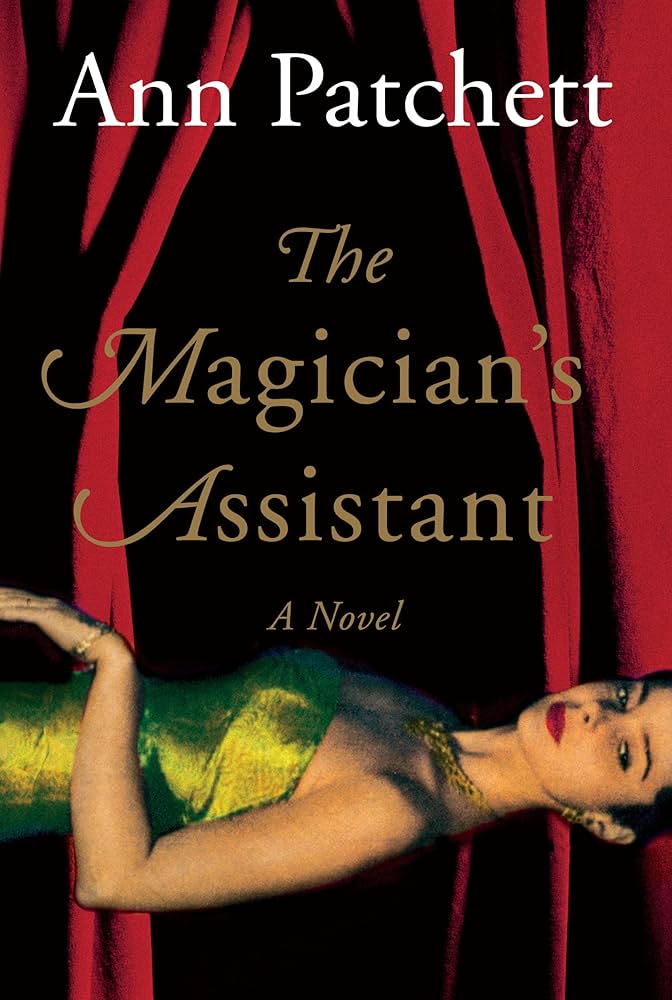

The Magician's Assistant
By Ann Patchett
Sabine– twenty years a magician’s assistant to her handsome, charming husband– is suddenly a widow. In the wake of his death, she finds he has left a final trick; a false identity and a family allegedly lost in a tragic accident but now revealed as very much alive and well. Named as heirs in his will, they enter Sabine’s life and set her on an adventure of unraveling his secrets, from sunny Los Angeles to the windswept plains of Nebraska, that will work its own sort of magic on her.
My thoughts:
I’ll admit something odd. Ann Patchett is one of my favorite authors, but I’ve only read four of her books. Every time I go to my shelf, I hesitate before pulling down another one. I think it’s because once I read it, I can never read it for the first time again. That’s the kind of magic her writing has over me. I picked up this book to fill a reading prompt, and it felt like slipping into something familiar. Patchett’s voice is steady, thoughtful, and precise, and it always feels like coming home.
The setup is as unusual as it is simple. Sabine has been assistant—and quietly in love with—Parsifal, a gay magician with a showman’s flair and a complicated personal life. She adores him and his partner, Phan. When Phan dies of AIDS, Parsifal marries Sabine so she’ll inherit his estate when the time comes. It’s an act of love, but not in the way most stories frame it. Soon after, Parsifal himself dies suddenly, leaving Sabine with not just grief, but a tangle of secrets he never shared.
On paper, it sounds like there could be fireworks—shocking reveals, messy betrayals, explosive drama. But Patchett doesn’t resort to that. The secrets Sabine uncovers aren’t about cheap thrills. They’re about identity, family, and the parts of ourselves we hide to survive. She learns Parsifal isn’t the polished, Connecticut-bred man he claimed to be. He came from a working-class Nebraska family, still alive and ready to meet her. What unfolds is less about spectacle and more about quiet rediscovery.
That’s the heart of the novel. Sabine thinks she knows this man she’s devoted years of her life to, yet here she is, realizing there’s a whole hidden history she’s only just beginning to see. The tension isn’t in whether she can solve the puzzle of his life, it’s in how she processes it, and how she reshapes herself in the wake of it.
I often gravitate toward stories of men who lived with HIV and died of AIDS. It was a terrifying and transformative era that shaped generations. Patchett treats it with care, never sensationalizing Phan’s death or Parsifal’s choices. Instead, she lets Sabine’s love for them both shine through, honoring the ways chosen family can be just as binding as blood.
And yet, I’ll be honest: I wasn’t as swept away by this one as I’ve been by some of Patchett’s other novels. The prose is, as always, near flawless. The characters feel lived-in and real. But the story didn’t grip me as tightly as I wanted it to. Maybe it’s because I went in expecting a bigger punch. Maybe it’s because Patchett’s quieter style worked against my own hopes for a little more drama.
That said, there’s still so much to admire here. The restraint. The empathy. The way Patchett lets grief and revelation unfold side by side without rushing either. Sabine doesn’t come out the other side with everything neatly wrapped up, and that’s okay. Reinvention isn’t a one-and-done trick. It’s slow work, and it’s never really finished.
Overall, not a total knockout, but still a beautiful, worthwhile read. If you’re a Patchett fan, you’ll find her usual brilliance in the prose and the characters. If you’re new to her, it’s a gentle introduction to her world.
Reading Challenge(s):


