




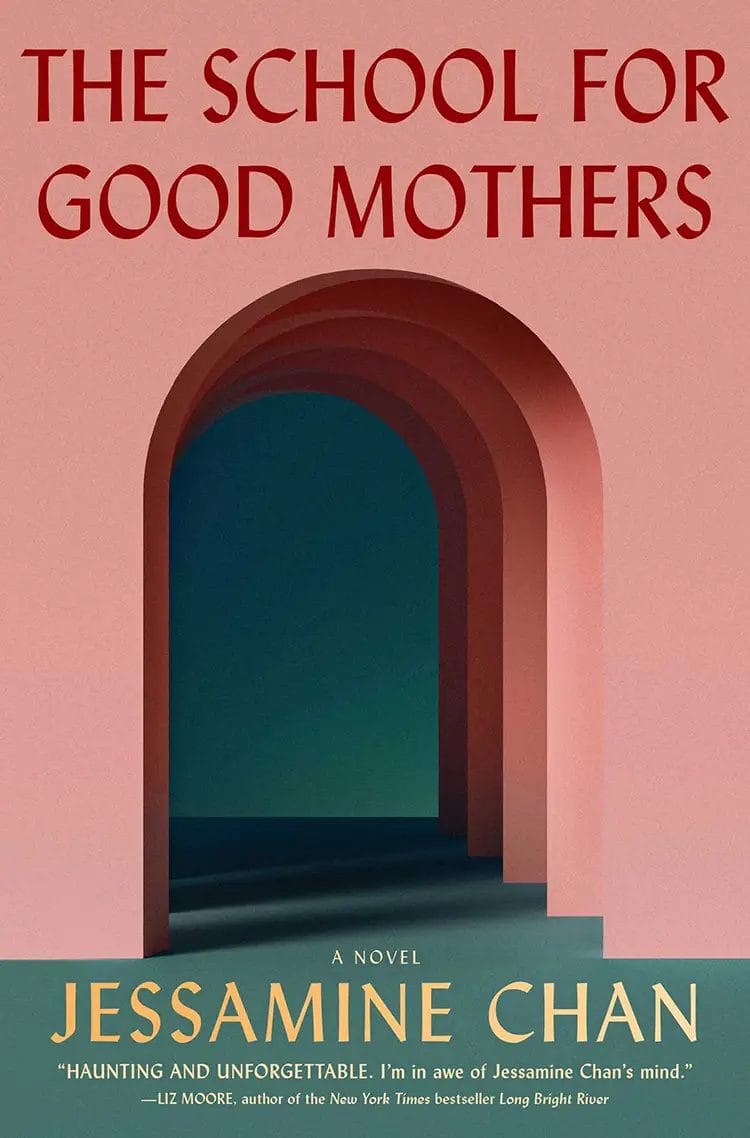

The School for Good Mothers
In this taut and explosive debut novel, one lapse in judgement lands a young mother in a government reform program where custody of her child hangs in the balance.
Frida Liu is struggling. She doesn’t have a career worthy of her Chinese immigrant parents’ sacrifices. What’s worse is she can’t persuade her husband, Gust, to give up his wellness-obsessed younger mistress. Only with their angelic daughter Harriet does Frida finally feel she’s attained the perfection expected of her. Harriet may be all she has, but she’s just enough.
Until Frida has a horrible day.
The state has its eyes on mothers like Frida — ones who check their phones while their kids are on the playground; who let their children walk home alone; in other words, mothers who only have one lapse of judgement. Now, a host of government officials will determine if Frida is a candidate for a Big Brother-like institution that measures the success or failure of a mother’s devotion. Faced with the possibility of losing Harriet, Frida must prove that she can live up to the standards set for mothers — that she can learn to be good.
This propulsive, witty page-turner explores the perils of “perfect” upper-middle-class parenting, the violence enacted upon women by the state and each other, and the boundless love a mother has for her daughter.
My thoughts:
I received a copy of this books courtesy of the publisher. All thoughts are my own.
There are books that feel like warning shots, and then there are books that feel like a prophecy. This one falls into the latter category. It reminded me a little of “The Handmaid’s Tale” mixed with “Orange Is the New Black” if it were set in a dystopian nightmare run by bureaucrats instead of wardens.
The premise is brutal in its simplicity: mothers who are deemed “unfit” are sent to a facility—sorry, “school”—to learn how to be better moms. Their crimes? Things like checking their phone for too long, stepping away for a moment of peace for too long, or just having a bad day. Once inside the “school”, they’re paired with eerily lifelike AI dolls meant to simulate their children, and they’re graded on every move, every tone, every emotional response. If they can’t hit a high enough score by the end, they lose access to their real children until they turn eighteen.
Divorced mother, Frida, our main character, lands in this nightmare after one bad decision on one very bad day. She’s exhausted, lonely, and clinging to what’s left of her self-worth when the system swallows her whole. Watching her navigate the absurd rules that demand robotic perfection and punish even the smallest hint of human emotion, was aggravating and horrifying. Chan makes you sit in that discomfort, forcing you to question not just how society judges mothers but how easily we let that judgment slide by under the guise of “child protection.”
And honestly? The most chilling part is how plausible it all feels. It’s not hard to imagine a world where the government, or some privatized version of it, monitors parenting under the banner of “safety.” Reading this as an American in the current climate hit hard. You can feel the frustration bubbling through every scene, especially when you realize how much of the system’s cruelty hides behind bureaucratic language and “for your own good” smiles.
What I appreciated most was that Chan didn’t wrap the story up in a neat, hopeful ending. There’s no sudden redemption that fixes everything. Instead, it ends in that murky, painful place where life often leaves us—unresolved but real. That choice gives the story even more weight.
The writing itself is sharp and precise. Every scene matters, and every emotion feels earned. She captures the claustrophobia of modern motherhood, where every decision is judged, recorded, and weaponized. And yet she also finds space for the raw, desperate kind of love that keeps Frida going even when the system tries to break her.
The “school” scenes were some of the most disturbing parts. The idea of these women practicing love and patience on robotic dolls that respond with scripted affection or cold silence depending on how well the mothers perform was unnerving. It’s the perfect metaphor for a culture that demands mothers be perfect machines rather than flawed humans.
By the end, I wasn’t just angry at the fictional world Chan created. I was angry at ours, because it doesn’t feel that far away. We already live in a country where women’s autonomy is being stripped away piece by piece, and where “good” and “bad” mothers are sorted into boxes that ignore the messy, human in-between.
Fair warning: This books is grim, infuriating, and sometimes hard to read, but it’s supposed to be. It’s one of those books that lingers long after you close it. It reminds you how easily freedom can slip away when we’re not paying attention.


